
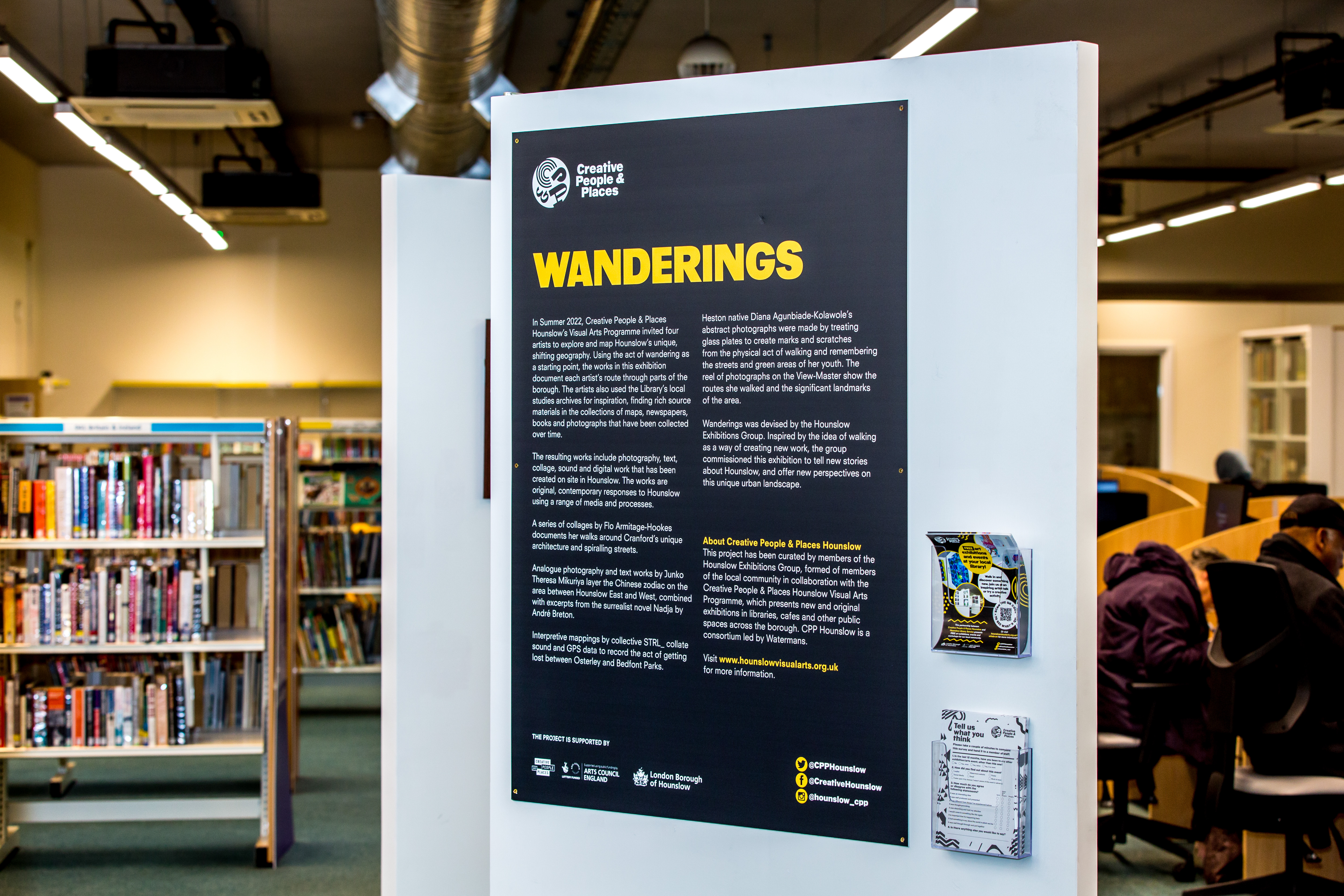

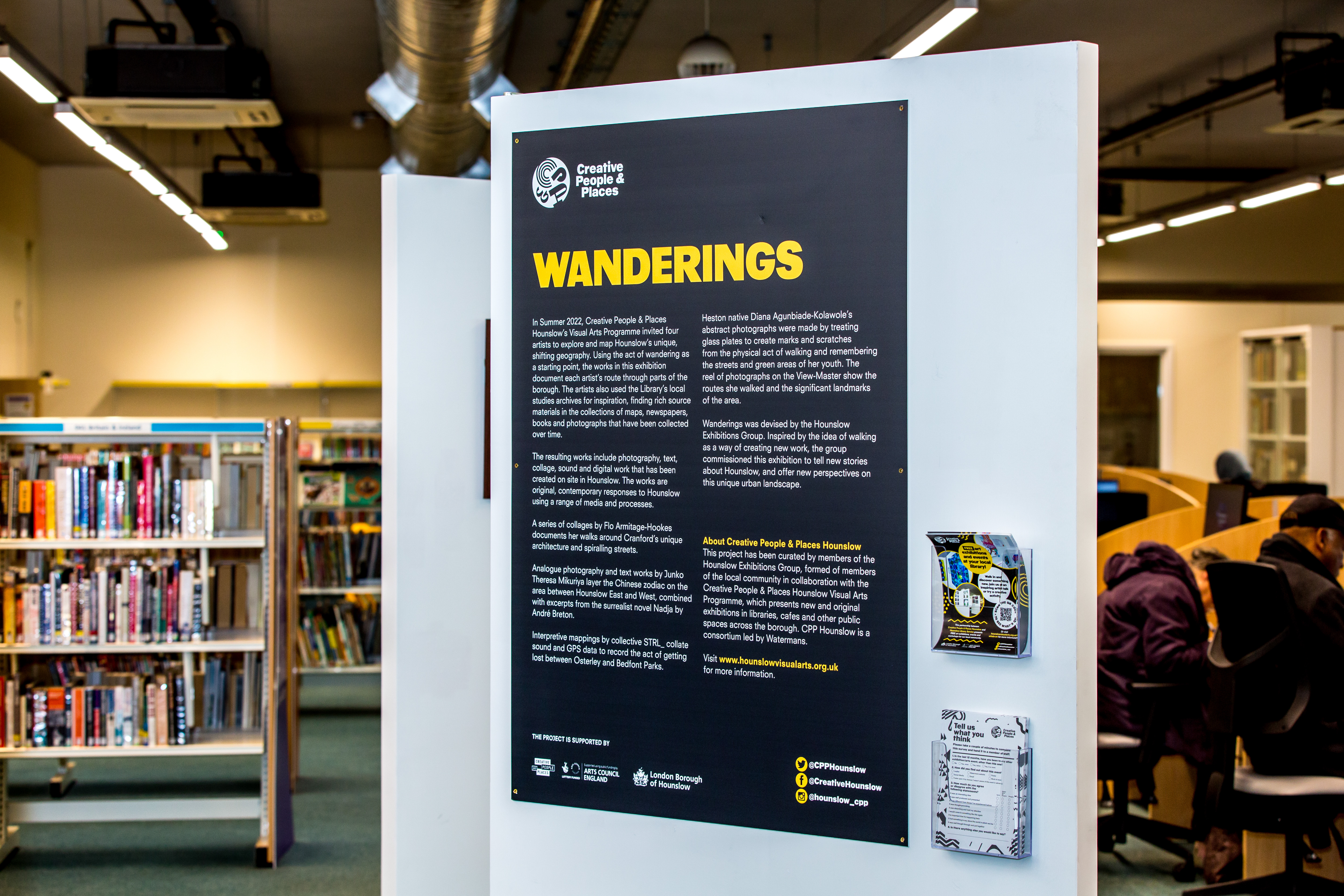




In Summer 2022, Creative People & Places Hounslow’s Visual Arts Programme invited four artists to explore and map Hounslow’s unique, shifting geography.
Using the act of wandering as a starting point, the works in this exhibition document each artist’s route through parts of the borough. The artists also used the Library’s local studies archives for inspiration, finding rich source materials in the collections of maps, newspapers, books and photographs that have been collected over time.
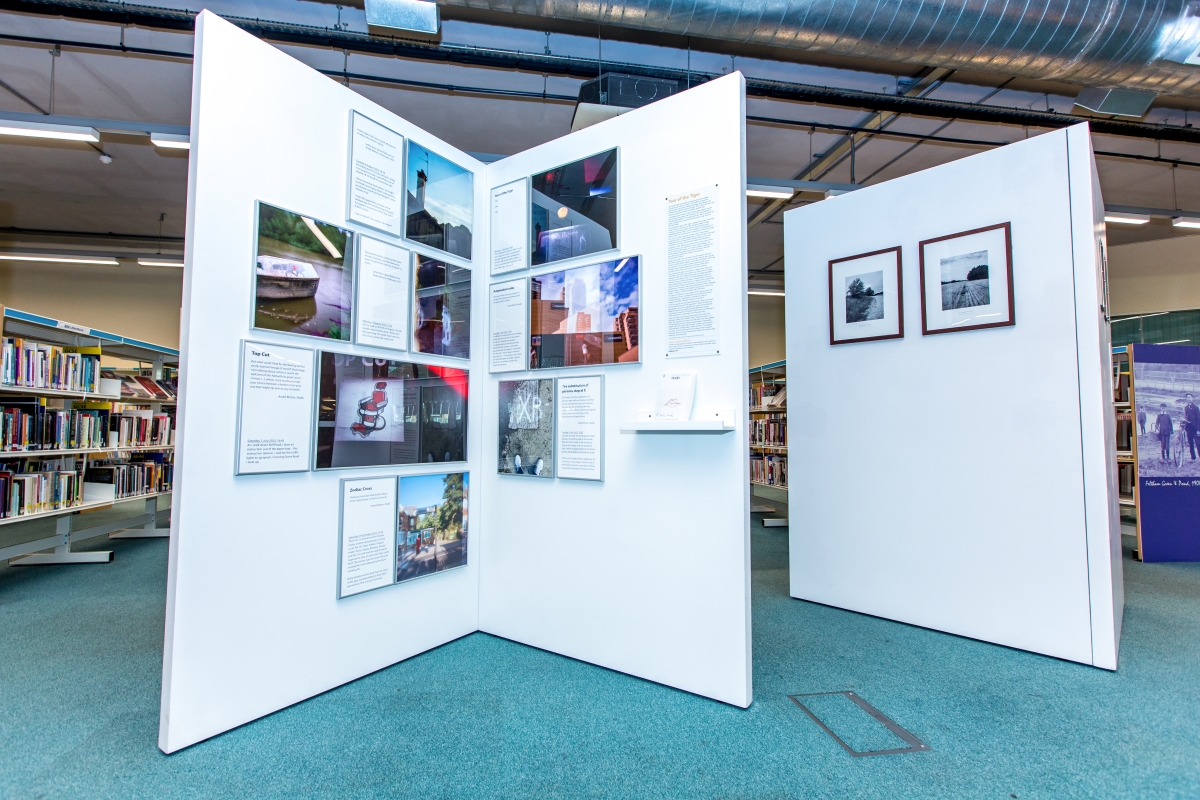
The resulting works include photography, text, collage, sound and digital work that has been created on site in Hounslow. The works are original, contemporary responses to Hounslow using a range of media and processes.
Wanderings was devised by the Hounslow Exhibitions Group. Inspired by the idea of walking as a way of creating new work, the group commissioned this exhibition to tell new stories about Hounslow, and offer new perspectives on this unique urban landscape
About the artworks in the exhibition:
o Pivoting point
~~ Wanderings
// Heston by Diana Agunbiade-Kolawole

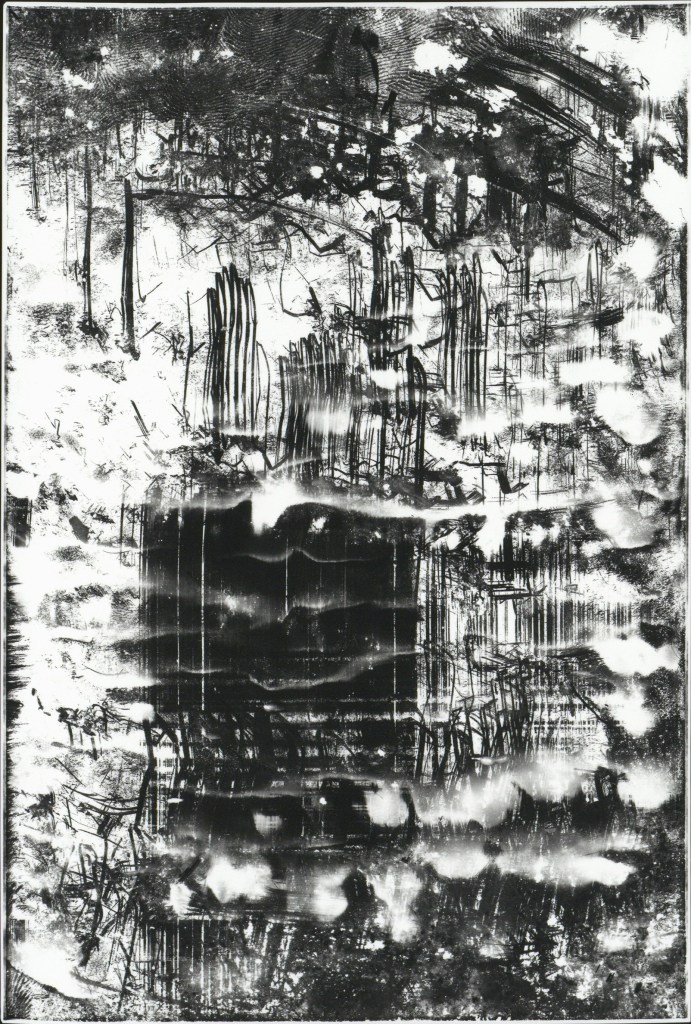
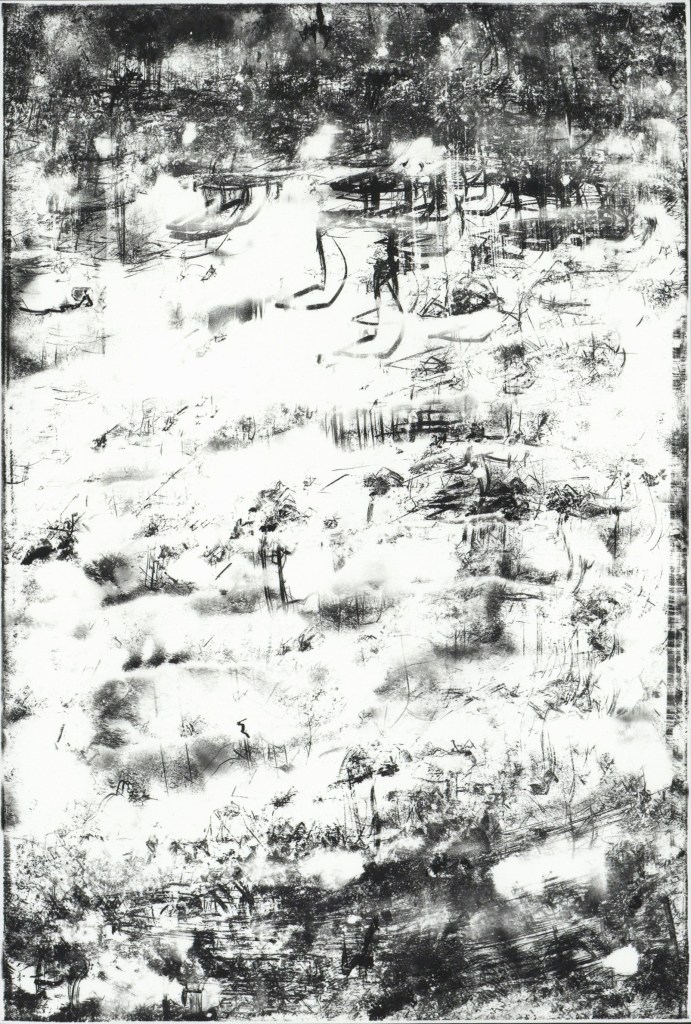


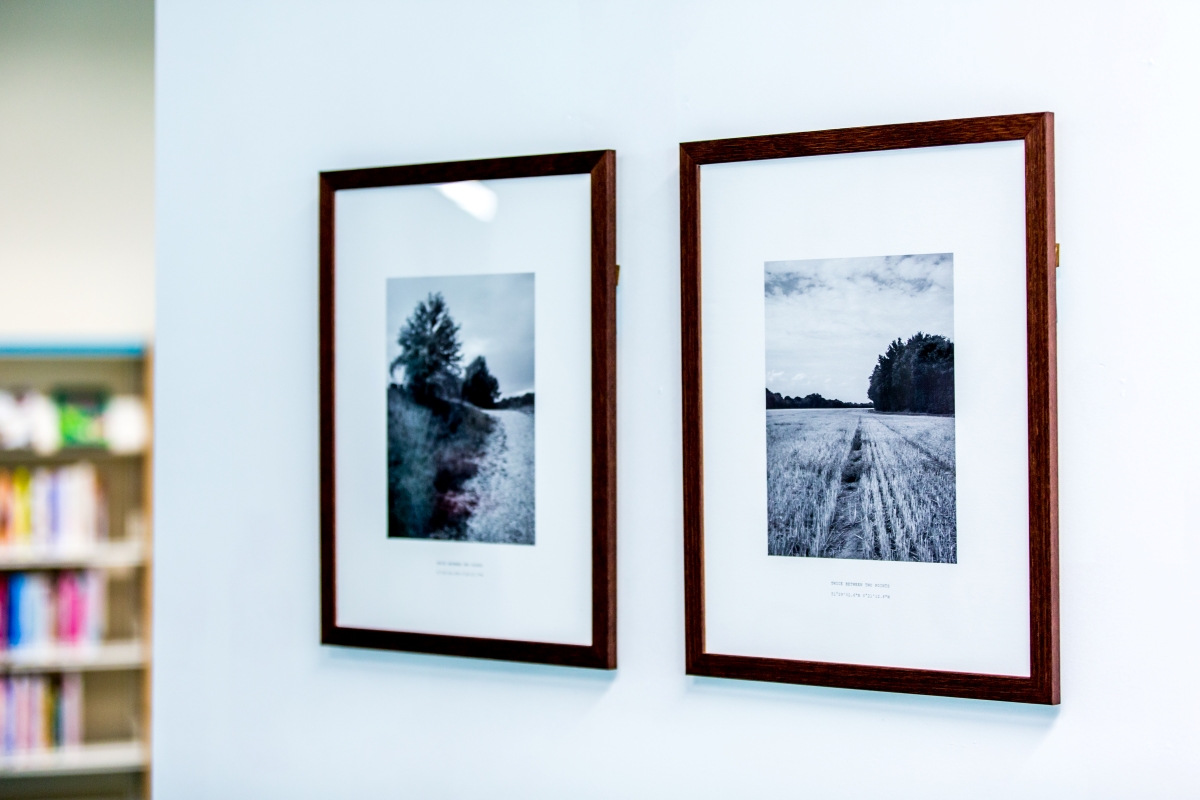
Heston native Diana Agunbiade-Kolawole’s abstract photographs were made by treating glass plates to create marks and scratches from the physical act of walking – a way of remembering the streets and green areas of her youth.
Diana is an artist working with photography. She grew up in Heston, and her ‘Wanderings’ project takes its starting point from a tree that her family planted in the year 2000.
From this point, she recreated some of the walks she did when she was younger, using cliché verre (glass plate) and camera photography to capture her walk. Diana is interested in the local area in relation to the legal property boundary lines and localised patterns that exist on them.
Diana is an artist working with photography. Her work utilises both lens and non-lens based photography, and these manifest themselves in a variety of outputs such as installations, performances and prints. She was selected as a British ambassador for UK/CHINA 400, an exchange of future leaders, China, 2009 and selected as part of the-dot 100 creative trailblazer in 2018.
Caught in the Curve by Flo Armitage-Hookes




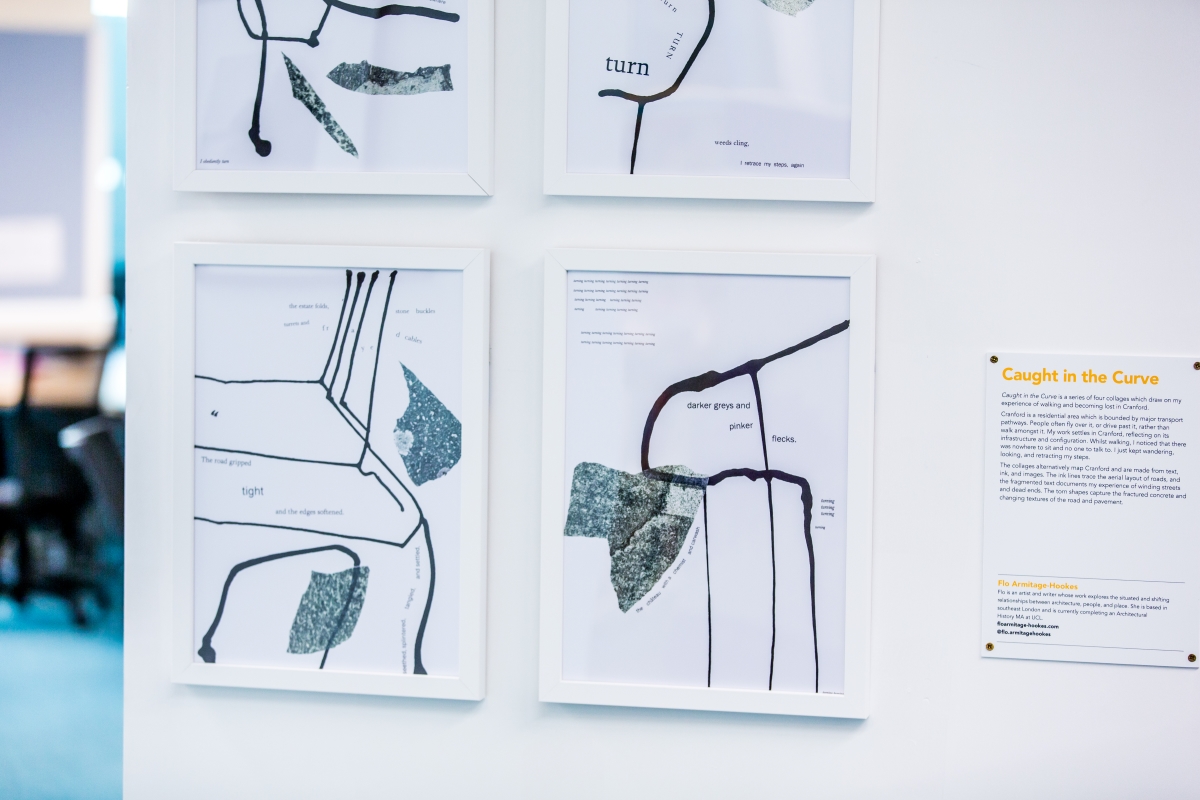
Caught in the Curve is a series of four collages which draw on Flo’s experience of walking and becoming lost in Cranford.
Cranford is a residential area which is bounded by major transport pathways. People often fly over it, or drive past it, rather than walk amongst it. Flo’s work settles in Cranford, reflecting on its infrastructure and configuration. Whilst walking, she noticed that there was nowhere to sit and no one to talk to. She just kept wandering, looking, and retracting her steps.
The collages alternatively map Cranford and are made from text, ink, and images. The ink lines trace the aerial layout of roads, and the fragmented text documents Flo’s experience of winding streets and dead ends. The torn shapes capture the fractured concrete and changing textures of the road and pavement.
Flo is an artist and writer whose work explores the situated and shifting relationships between architecture, people, and place. She is based in southeast London and recently completed an Architectural History MA at UCL.
floarmitage-hookes.com
@flo.armitagehookes
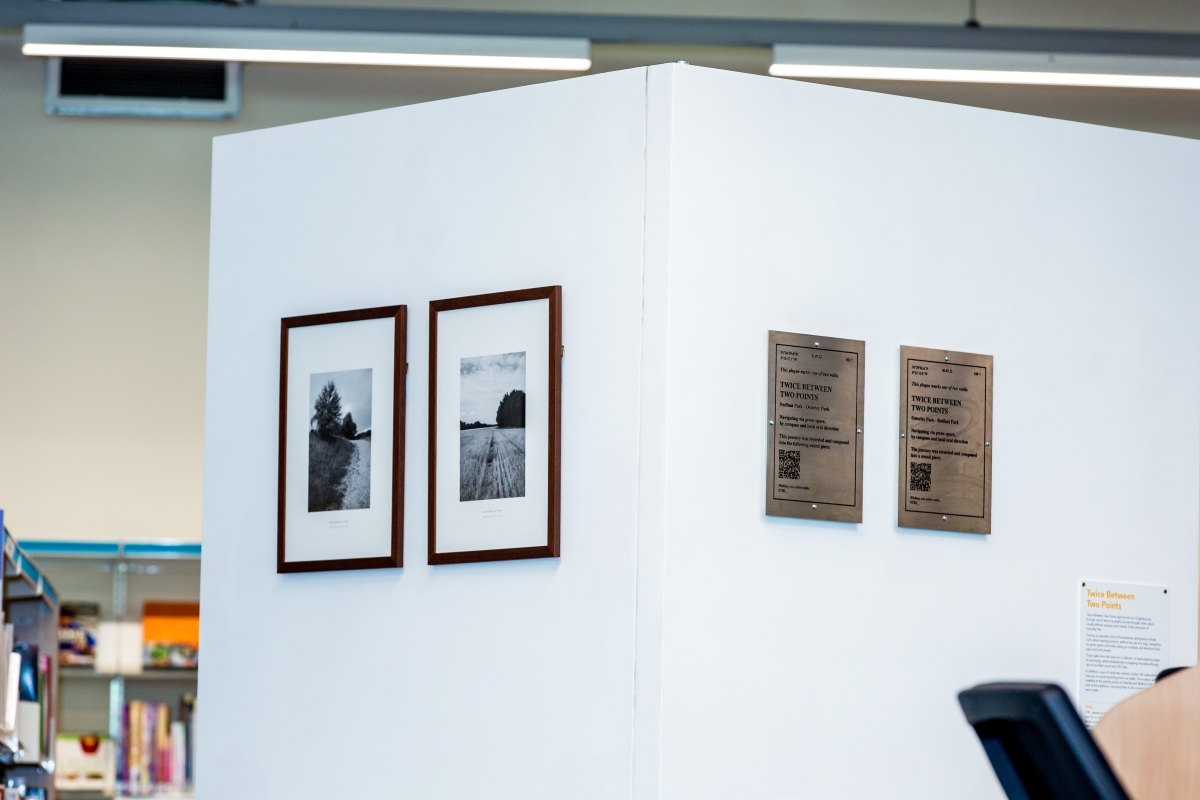
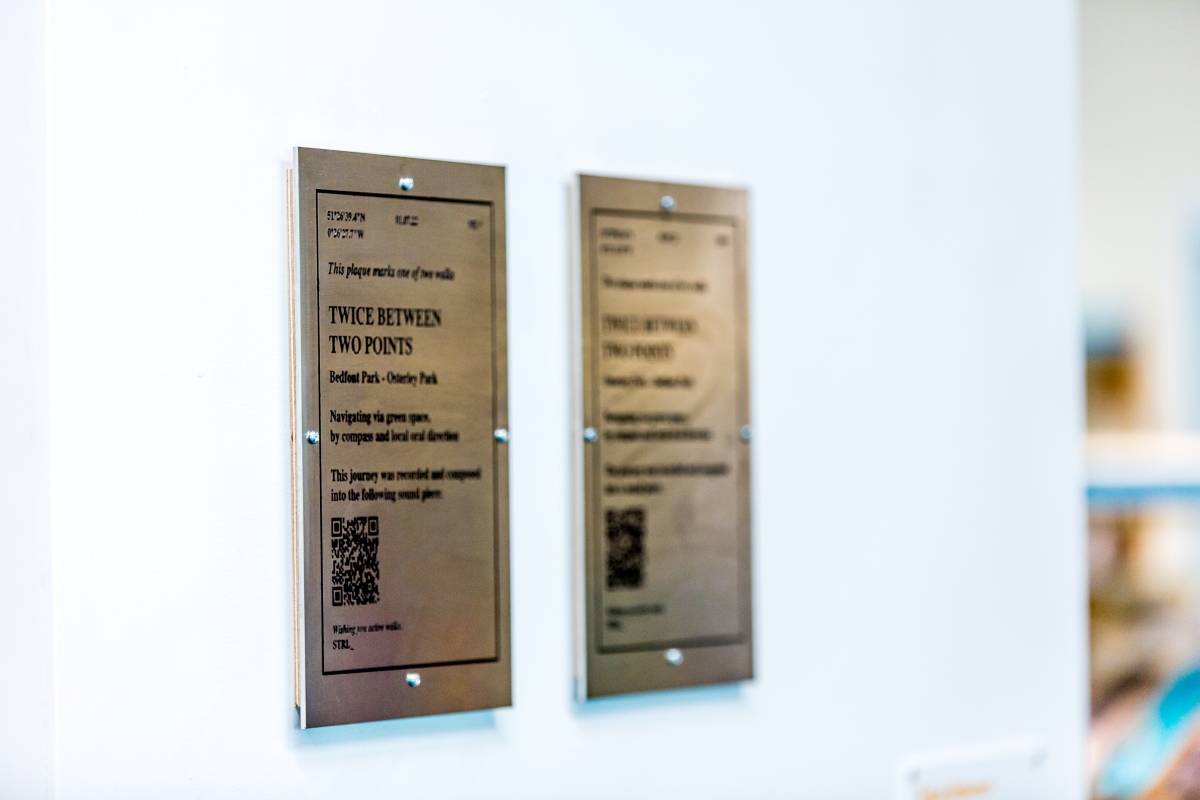
Twice Between Two Points by STRL_

Twice Between Two Points explores the act of getting lost, through use of derive (a playful journey through urban place, usually without purpose and outside of the structures of everyday life).
Starting at opposite ends of Hounslow we attempted to locate each other’s starting position, without the use of a map, navigating via green space and solely relying on compass and directions from signs and local people.
These walks form the basis for a collection of work exploring ideas of journeying, whilst interpretively re-mapping Hounslow through use of recorded sound and GPS data. Listen to the sound piece here.
STRL_ operates as a spatial practice. We look to use walking as a starting point for our work – exploring an intersection between landscape, land art and architecture. (Lucius Burkhardt’s theory of strollology has always been a great inspiration for us). As a cross-disciplinary research praxis we seek to find ways from which we can learn from the land, and challenge human relationship to surroundings – interrogating the relationship between body and space.
Year of the Tiger by Junko Theresa Mikuriya
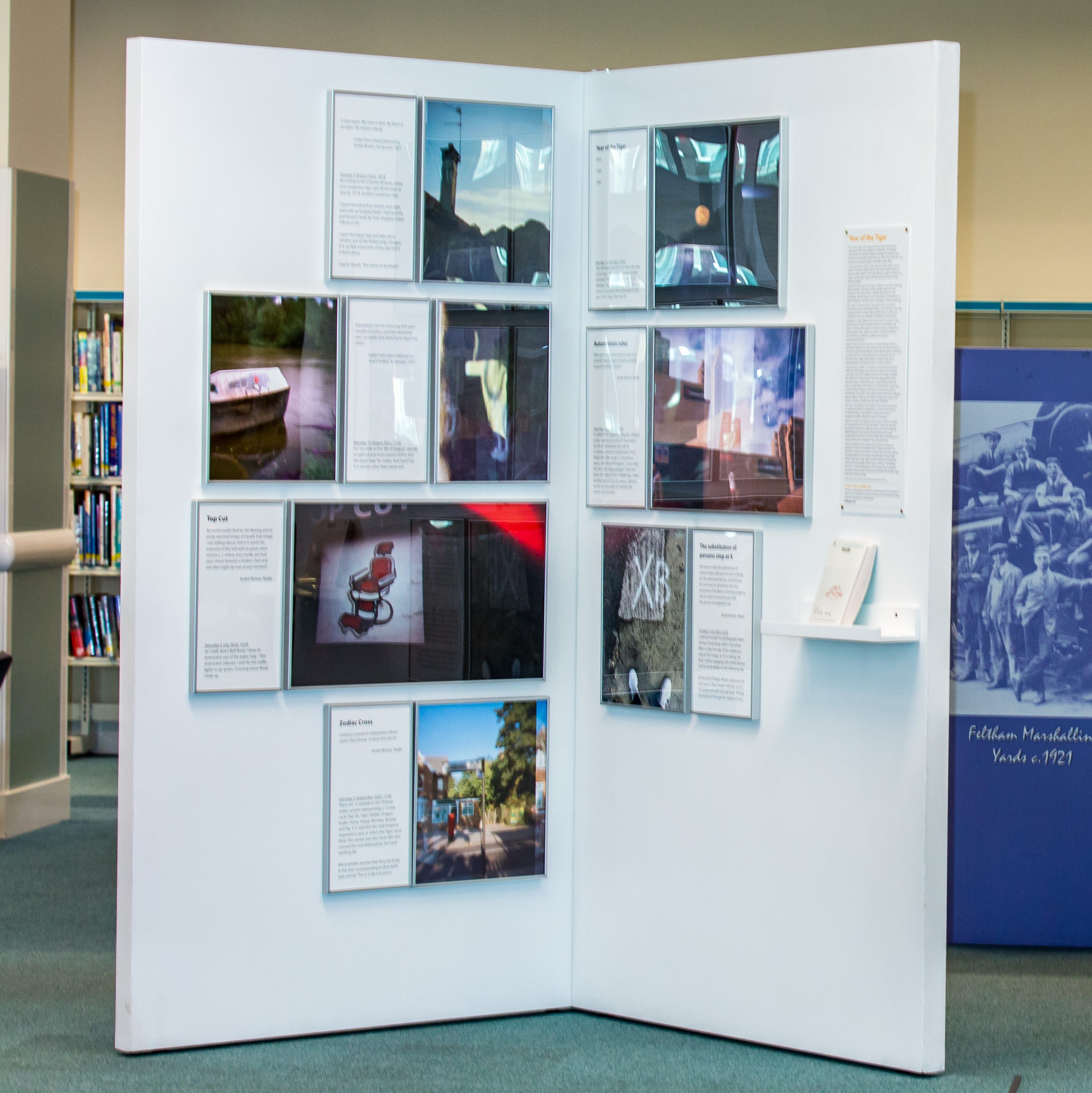
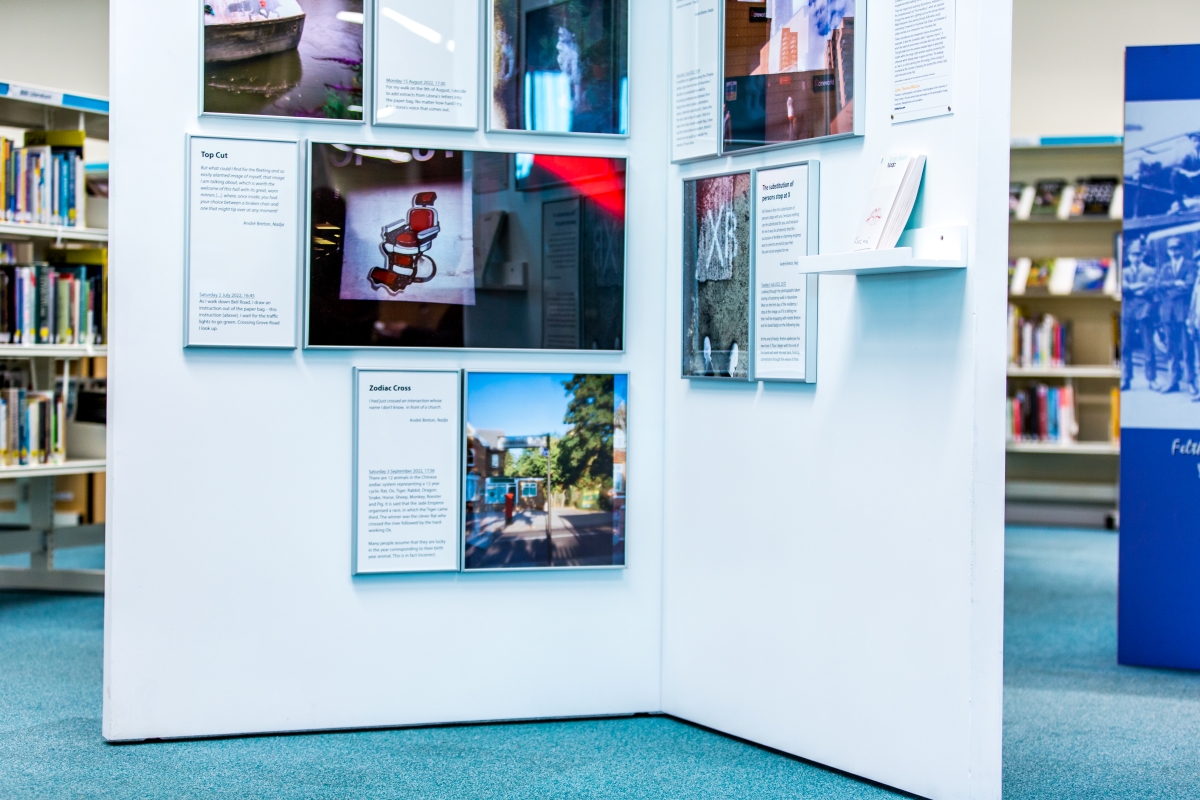
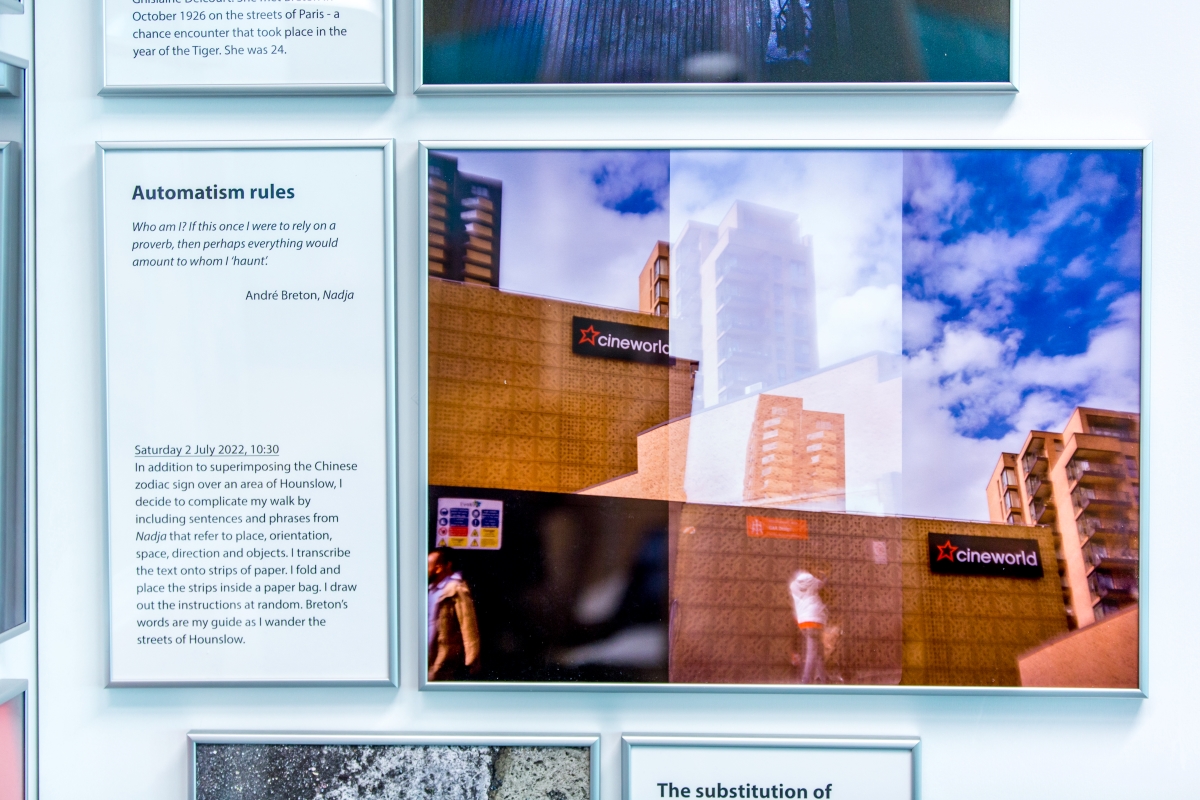
Year of the Tiger is an image and text project that explores Hounslow town centre through a combination of Surrealist interventions and ancient Chinese astrology. According to the Chinese lunar calendar, 2022 is the year of the Tiger, with the most auspicious positions located in the West and the East.
Theresa superimposed a map of the Chinese zodiac over an area of central Hounslow, with the sign of the Tiger located on Hounslow West station. The zodiac became a way to structure jer walks, creating links, routes and directions that she may not have otherwise taken.
Starting from the sign of the Tiger, Theresa walked to the signs of the Pig, Horse and Dog. The choice of the animals is based on their positions in the zodiac system.
Elements of chance quickly became important to the development of this project. Happening upon XB written in the road, Theresa recalled a key Surrealist text Nadja by André Breton.
Published in 1928, Nadja recounts the chance encounter in Paris between Breton and a mysterious woman named Nadja. The book, containing 48 images, is a mixture of genres, ranging from autobiography, diary, ghost story, dream transcript, detective story, love story, guide book, medical case study, to anti-psychiatry polemic.
Nadja, whose real name was Léona Camille Ghislaine Delcourt (and whose identity was only uncovered less than 20 years ago by the Dutch author Hester Albach), is described by Breton in his book as a free spirit and a natural Surrealist. Assuming the role of Surrealist muse, Nadja guides Breton through a Paris that is populated with enigmas and instances of the marvellous.
Theresa documented my walks in Hounslow on expired film stock from 1996 (Year of the Dog) using a plastic toy camera and a vintage camera from the 70’s.
These photographs are shown alongside selected excerpts from Nadja and letters from Delcourt to Breton that referred to place, location and space. Theresa copied these texts onto strips of paper which she then drew out at random from a paper bag during her walk. She used the words of Breton and Delcourt as instructions for her wanderings in Hounslow.
The state of receptivity to the rhythms of the exterior world and an awareness of how it corresponds to one’s inner self is key to Surrealist thinking. Theresa tried to cultivate this awareness whilst walking the streets of Hounslow.
Magical instances (what the Surrealist would call the “marvellous”) were captured through my camera lens. Theresa had sightings, such as the German theorist Walter Benjamin’s face peering through fluffy white clouds overlooking Cineworld on Hounslow High Street, and shadows of zodiac animals at an intersection near Hounslow East.
These coincidences and unexpected chance encounters are what the Surrealists called “objective chance”, in which the external environment coincides with one’s inner desires. The light leaking from my camera revealed layers of ghosts, hidden within the image. Light sensitive material can uncover the otherness which already exists in space and time. The leakage is a force from the light and energy of the ecology of Hounslow in real time.
The project is a dialogue between Breton, Delcourt and Theresa herself, crossing time, space, and borders – a surrealist mash-up of 2022 Hounslow with 1926 Paris.
Theresa is a photographer, and teacher of photography at the University of West London. She also writes books and essays on the photographic image, mysticism, Neoplatonism and Surrealism.
 CPP Hounslow