Overview
The Hounslow Exhibitions Group is an informal group that meets monthly. It is formed of library staff, artists and members of the local community with an interest in visual arts. The Group is supported by a Visual Arts Producer. Meetings have taken place at various venues in Hounslow, but currently are taking place very successfully online using Zoom. The meetings are supplemented by email communications, and (where possible) visits to exhibitions.
The purpose of the group is to select exhibitions for the Visual Arts Programme, ensuring quality and relevance for local audiences. The role of the Group is outlined in a document that is regularly updated in consultation with the group, detailing what the group does, how decisions are made, and ensuring conflict of interest issues are clear from the outset.
Context
The Visual Arts Programme was added to Creative People and Places Hounslow’s programme in its second phase, beginning in April 2018.
The Programme is delivered in partnership with the Hounslow Library Service, and aims to show contemporary visual arts of the highest quality across six Libraries, and a network of cafes, based on the Salisbury Café community gallery model.
The vision for the programme is that it is led, selected and curated by local people, supported by CPP Hounslow.
It is envisaged that the Visual Arts Programme will be led by Hounslow Library Service at the end of Phase 3, so much of the work being done now is to create a committed group with clear objectives, and developing the skills and knowledge that the panel and library service will need to continue independently.
Approach
The approach taken with setting up and working with the panel has been one of trial and error. We’ve tried several approaches, and the current seminar style approach with plenty of structure works well.
The group makes selections and programming decisions guided by the Visual Arts Producer, using questions, examples and activities to generate ideas, and to select projects for further development.
The aim is for a flat structure, with the decision-making led by the group rather using facilitation rather than a management style. The panel are encouraged to share ideas, challenge and critique and to lead on ideas that excite them where they are able.
The programme somewhat turns the traditional hierarchy of curatorship and authorship around, so that multiple voices lead and shape themes, ideas and concepts. The openness of the group allows for different perspectives and experience to influence how and what is selected. The community focus means that the projects have a local flavour and relevance, a principle that is at the fore of the decision making within the programme.
This curatorial approach over a sustained period and across multiple projects represents a significant and distinct professionalism, fairly unusual for a community led programme. The Group members are often referred to as ‘Community Curators’, a term that denotes the authority of the Group to select, choose, and critique using their wide range of experiences.
Development
The HEG evolved from the set-up of the Visual Arts Programme. A panel of local people and library staff was written into the Business Plan for Phase 2. These were initially set up locally in Bedfont and Heston, mirroring the LAG model.
Due to staff change, these groups had several meetings, but without much direction. The original vision of very local groups felt at odds with a borough-wide programme, with challenges around travel, access and the positioning of the programme quickly coming to light. The groups also had a focus of working on single exhibitions, rather than having ownership and oversight of the VAP as a holistic piece of programming work. This led to a reconsideration of this set up, and led to the development of one group rather than several.
The Heston group was successful, working on a project initially around the theme of Reflection – but this was not sustained, having a natural ending at the delivery of the project. The project which become The Memory Library, was very successful, with the group advising and directing the artist, with the relationship being one of mutual respect, exchange and learning. The evaluation process showed that the group enjoyed being part of the project.
In June 2019, it was decided to set up a central panel, to oversee the whole programme. This represented a shift towards a more sustained programme-based outlook, as opposed to distinct project-based groups. The challenge of this new approach was to keep interest in the group going, avoid too much complication, and to deliver tangible results that the group would feel invested in and sustain their enthusiasm and enjoyment.
Some members of the Heston group joined the HEG, but others felt they preferred being connected in a more local way. These members were signposted to LAGs as a way of being involved with CPP activity in their local area.
The central panel originally met twice a month, at Feltham Library and in Hounslow Town Centre. This actually recreated the original problem of two panels, as the two meetings were often attended by different people. Due to a changing membership, and some sensitive topics being discussed, these meetings were often difficult, fractious and lacking direction.
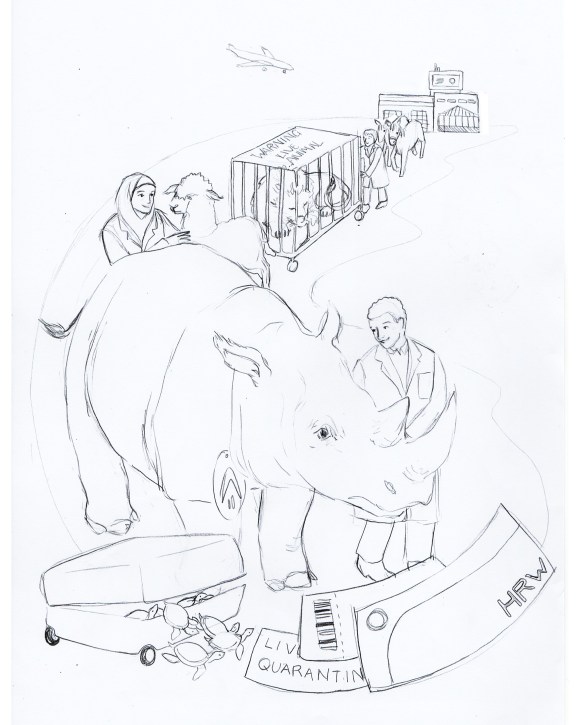
In January 2020, one of the two monthly meetings was disbanded, in favour of a monthly meeting. The group has since met monthly and continued to work together on two exhibitions: Animal Stories and What You Do Not See. Further Phase 3 projects are now in development, provisionally titled Mending Community and Atmospheric Colour.
It also became apparent that there was insufficient time to curate exhibitions, and many people in the group are time-poor, and not able to dedicate a lot of time to curating exhibitions. To mitigate this, additional meetings are hosted with sub-groups, who work on specific projects if they wish to, but also attend the main monthly meeting to maintain oversight of the programme. This approach has worked well, and given the programme the required breadth and depth of community involvement.
A turning point for the development of the group came in April 2020 with lockdown. With little choice but to move online, the meetings were hosted on Zoom, with a presentation style format, and a much more structured discussion to accommodate the challenges of working virtually.
The first meeting in April was very well attended, and had a good response. The attendance has since remained higher than previously, with more regular attendance from more people. This has consolidated the group, making it more stable. The group has also become more experienced and understand the objectives and purpose of the programme.
Screen sharing also allows for more sharing of visuals, and has transformed the feel from a meeting by agenda, to a seminar style group which has enabled much richer discussions.
We have also recently made the shift from a commissioning to a selecting model for projects. This is partly to a reduced budget in Phase 3, and also to ensure sustainability and reduce the resources required (in terms of time, money and equipment) to make exhibitions in future.
Since March, more members have joined the Group, and are attending regularly, bringing increased expertise, local knowledge and perspectives, which is really important. A diversity of tastes, ideas and cultures will all be important for the group to ensure the programme remains exciting and relevant in future.
The Group is deliberately left as open as possible, and anyone can join. Members often attend after nearing about the panel through word of mouth from other members, or CPP staff, while other members have joined after picking up leaflets in their local libraries.
We don’t ask for members to have any particular qualifications or expertise, instead asking just for time and enthusiasm. The Group acts with an impressive professionalism and integrity, learning each month through doing, thus developing a practice together and shaping the programme using knowledge and skills, both learned and tacit.
The vision for the future is to continue working together online for monthly meetings, supplemented by email communications and discussion. This will be combined with visits to exhibitions so members can learn from other programmes, and meet each other in a more social setting and discuss the exhibitions and what they could apply to the programme.
Challenges
A significant challenge has been ensuring clarity about the Visual Arts Programme. In particular, the rationale behind the framework of using Libraries and Cafes as venues. There have also been questions around the role of the group, and shifting focus towards audience experience and engagement, and away from artist development. The role of the group is defined as curating and selecting, rather than administration. The name of the group has also recently changed from Curatorial Panel to Hounslow Exhibitions Group, with the aim of making the objectives of the group more accessible and clearly defined.
A second significant challenge has been the need to learn as we go, trying things and changing, which some of the group have found difficult. This has been mitigated by holding meetings online, with a more structured format, and allowing for intuitive ways of working and thinking, and encouraging discussion and creative solutions to generating programme ideas.
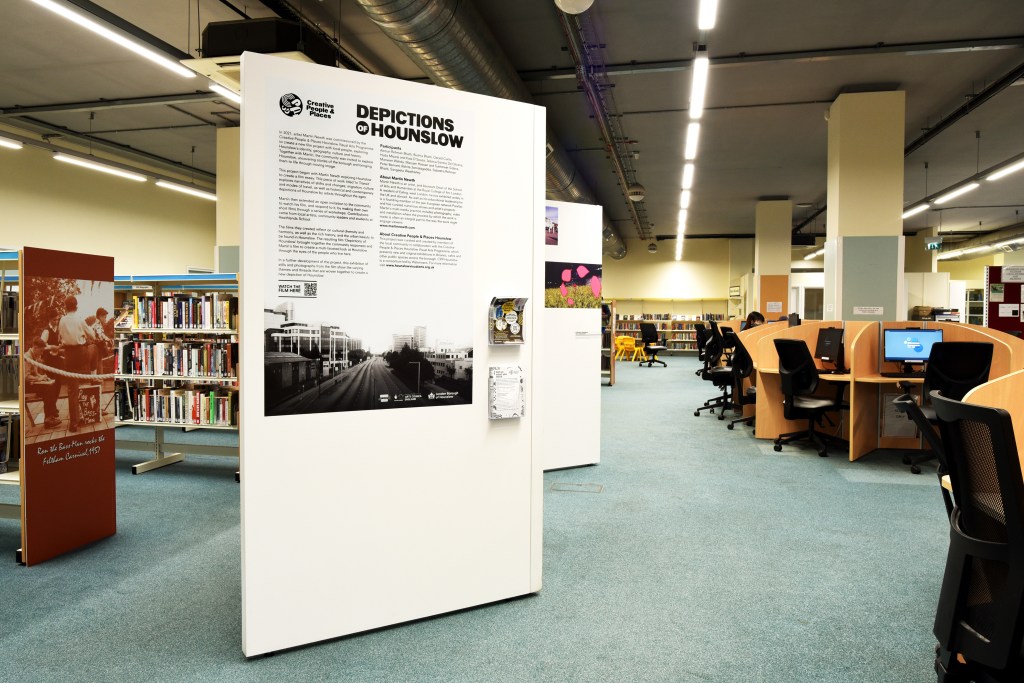
The third challenge has been around the practicalities of the programme as well as hosting the group, such as how to hold exhibitions in libraries when there is no existing infrastructure, and where to hold meetings that is accessible for everyone. The solution to infrastructure has been an investment in exhibition walling that is flexible and can be configured in different ways. This has created a defined ‘space’ in which to hold exhibitions, and makes it easier for the Group to understand and visualise what is possible, and also know where the limitations are. The issue around where to hold meetings has been resolved by holding them online.
A further challenge has been sustaining and maintaining the membership of the group. This has worked well when time has been invested in developing more personal relationships with individuals, and ensuring that needs are being met, and that everyone has the chance to contribute. Members who feel that they are gaining as well as giving to the programme attend more regularly.
What Works
Throughout the past 14 months, we have discovered what works through trial and error, and from gathering informal feedback from the group.
What we have found that works well includes the use of resources, showing images, and diagrams to describe the processes of exhibition development and commissioning or working with artists. This helps to create a sense of where we are in the project, and the roadmap ahead. It’s also a good way for us to chart progress as a group, and to feel that we are making steps towards a tangible outcome, even when this may feel slow month to month.
Similarly, holding structured meetings, with conversations carefully steered by asking the ‘right’ questions really helps to create a sense of progress and engagement among the diverse members of the Group. The more focus in the sessions, and having defined outcomes for each session helps to keep us on schedule and stops either sessions or projects from drifting away into more general discussions.
Within the sessions, the content has been carefully structured so as to simplify complex details rather than to ‘dumb down’. There is a huge range of experience and knowledge in the group, so the sessions have been balanced to keep the interest of those with lots of specialist visual arts knowledge, as well as members of the group who attend with a more community-centred focus. This is done by asking broad questions, for example:
What do you like?
What don’t you like?
Is there something you find challenging?
How does it make you feel?
What stands out?
What would you like to see if you walked into your local library today?
These questions require very little jargon or specialist vocabulary, and everyone is asked to write down thoughts and share back to the group (if they wish to). The openness of the questions, but focussed on very specific ideas, creates a forum for sharing on a range of levels from the very personal to the more theoretical. As the Group becomes more embedded and the members know each other, and CPP staff better, trust has built, which encourages more members to share their opinions without being concerned if their ideas are the ‘right’ ones.
The mix of people in the Group has also been important. The dynamics of having a balance of people, experiences, cultures, ages, a mix of genders, as well as those identifying as professionals or not, helps to ensure a real range of views and representation. CPP staff have made an effort to champion all types of expertise and experience, cultivating a culture of leadership and pro-action within the group.
An effort has been made to build more personal relationships between CPP staff and the Group members, having 121 conversations with members where needed, or sharing further reading and insights by email between sessions for those who want it. This has helped to create an atmosphere of mutual learning, trust and understanding, which in turn has built confidence and knowledge. These human relationships have been perhaps the most important part of the programme, forming the foundation of how the Group works together and becomes more assertive and assured.
A sustained membership has been achieved by ensuring there are tangible personal and professional benefits for individual members. This may be a group visit to a gallery for inspiration, taking on the leadership for a project or idea, or even the tacit learning that happens by doing. This ‘give and gain’ approach has worked really well, and ensures that group members who invest their time gain something useful and fulfilling that they can also apply within their personal and professional lives outside of the programme.
Learning
The approach and development outlined above are continuously evolving. This case study is intended to provide a snapshot of our current practice and reflects on what we have learnt so far in the process of developing the Hounslow Exhibition Group.
To summarise, what we have learnt is that:
It’s important to put the community in the driving seat of the creative and curatorial direction of the programme, without the weight and expectation of delivering the administrative or organisational parts. The focus is on themes, ideas, concepts and quality of art. This stops the Group from turning into an administrative committee, and ensures the sessions and work are interesting and inspiring.
Meeting online via Zoom has transformed our work together, and offers a more collaborative space that focuses attention, and allows for the sessions to have a seminar-style format that has not previously been possible. It has also mitigated issues for members around getting to various venues, and the challenge of finding suitable spaces to meet.
Clarity is deeply important. A lot of work has been done to ensure Group members understand the purpose of the Programme, its aims, objectives and proposed outcomes. This has gradually become more embedded and the Group now has a better understanding of their roles as individuals and a team.
Structure has created a more focused tone to the monthly sessions. This has been achieved over many months of trial and error, and listening to feedback. Where early sessions had often veered into discussions about the structure of the programme itself, now they have a real sense of direction and purpose which has been cultivated over a long period.
This structure has been matched with an effort to build a rapport with individual group members, to build a culture of trust, sharing and questioning assumptions. The group has become more outward-looking, focusing on the experiences of the audiences who will visit the exhibitions. The group decision making is democratic, with all voices heard and considered. There is now a sense of civic pride in developing a programme for the community’s benefit that is becoming more and more tangible each month.
Developing relationships and gradually building confidence and leadership within the Group has been really important. This has created a sense of trust and purpose. When members suggest ideas that are taken forward, there is a real sense of achievement, and the message is that members’ influence and insight are important and create real world results.
Author: Daisy McMullan, Visual Arts Producer, CPP Hounslow







 CPP Hounslow